
How to Track Your Dog's Weight at Home (and Why It Matters)
Updated July 2026
To track your dog's weight at home, weigh them on the same scale at the same time of day, then record the number so you can watch the trend. For small dogs, step on a bathroom scale holding your dog, then subtract your own weight. For larger dogs, use a flat pet scale or ask your vet clinic to use their walk-on scale. Weigh healthy adults weekly and growing puppies more often, and log each result to catch changes early.
Why tracking your dog's weight matters
Weight is one of the most useful health signals you can measure at home, because a change in weight is often the first visible sign that something is off. A dog that is quietly losing weight may have a dental problem, a digestive issue, or another condition long before other symptoms appear. A dog that is slowly gaining may be heading toward the joint strain, breathing difficulty and shorter lifespan that come with excess weight.
The problem is that these changes happen gradually. When you see your dog every day, a slow drift of a pound or two is almost impossible to notice by eye. A written record removes the guesswork: instead of "he looks about the same," you have an actual line you can follow, and you can hand your vet real numbers instead of impressions.
How to weigh a dog at home, step by step
You do not need special equipment to get a reliable number. Pick the method that matches your dog's size and keep it consistent.
Small and medium dogs: the hold-and-subtract method
- Step onto a normal bathroom scale by yourself and note your weight.
- Pick up your dog, step back on, and note the combined weight.
- Subtract your weight from the combined figure — the difference is your dog's weight.
A digital scale is easier to read than a dial scale, especially for small changes. If your dog wriggles, wait for the reading to settle or take the measurement twice and use the closer pair of numbers.
Large dogs: pet scales and vet scales
Holding a big dog is neither safe nor accurate, so for larger breeds use a flat walk-on pet scale if you have one, or take advantage of the walk-on scale most vet clinics keep in the waiting room. Many clinics are happy for you to pop in for a quick weigh-in between appointments — it is worth asking.
Keep the conditions the same every time
Consistency matters more than precision. Weigh your dog at the same time of day — first thing in the morning, before food and after a toilet break, works well — and use the same scale each time. A meal, a big drink of water or a full bladder can easily add noticeable weight, so a routine keeps your readings comparable. For healthy adult dogs, once a week is plenty. For puppies, who grow fast, weigh every few days so you can see the growth curve clearly.
Tip: Snap a quick photo at each weigh-in. Looking back at photos alongside the numbers makes it much easier to see body-shape changes that a single figure can hide.
What is a healthy weight for a dog?
There is no single "correct" weight, because healthy weight varies enormously by breed, frame and age. A number that is perfect for one dog would be underweight or overweight for another of the same breed. Rather than chasing a fixed figure, vets look at body condition score — a hands-on assessment of whether you can easily feel (but not see) the ribs, whether there is a visible waist from above, and whether the belly tucks up from the side.
Puppies are a special case: they should gain steadily, and a healthy growth curve matters far more than any single reading. For any dog, the trend is what tells the story. A stable line week after week is reassuring; a steady climb or drop is your cue to look closer. If you are unsure what your individual dog should weigh, your veterinarian can set a target based on their breed and body condition — that is a better anchor than a chart of averages.
When to worry about weight changes
Sudden or unexplained weight loss
Losing weight without a diet change is worth taking seriously. As a general guide, a drop of more than about 5% of body weight, or any rapid loss over a week or two, is a reason to call your vet — especially if it comes with reduced appetite, vomiting, diarrhea, low energy or increased thirst. Having a dated record of when the loss started and how fast it happened helps your vet enormously.
Steady, creeping weight gain
Gradual gain is easy to normalize but hard on your dog's joints, heart and lifespan. If the trend line keeps rising, review portion sizes, treats and exercise, and ask your vet whether a weight-management plan makes sense. Rule out medical causes too — some conditions cause weight gain — rather than assuming it is just diet.
When in doubt, call the vet
You know your dog best. If the numbers, appetite or energy don't feel right, a phone call to your vet is always the safe move. Weight tracking is a screening tool, not a diagnosis — its job is to help you notice a change early enough to do something about it.
The easy way: track dog weight with PetnotePlus
Writing weights on a sticky note works right up until you lose the sticky note. A pet care app keeps every reading in one place and draws the trend for you, so you can see the line at a glance instead of doing math. Here is how to do it in the free PetnotePlus app:
- Add a profile for your dog. Enter their name, photo and birthday so weight readings live alongside the rest of their health records.
- Log the weight in Today's Entries. Tap to record the number in seconds, and attach a photo from that day so you can review shape and size together.
- Set a weekly reminder routine. Turn on a weekly (or, for puppies, more frequent) routine so a weigh-in is never forgotten.
- View the trend chart. Open the weight chart to see the trend over weeks and months, and compare weight against other items on a single graph.
- Share with your family. Share the pet with up to 15 family members so whoever is home can weigh in — everyone sees the same up-to-date history.
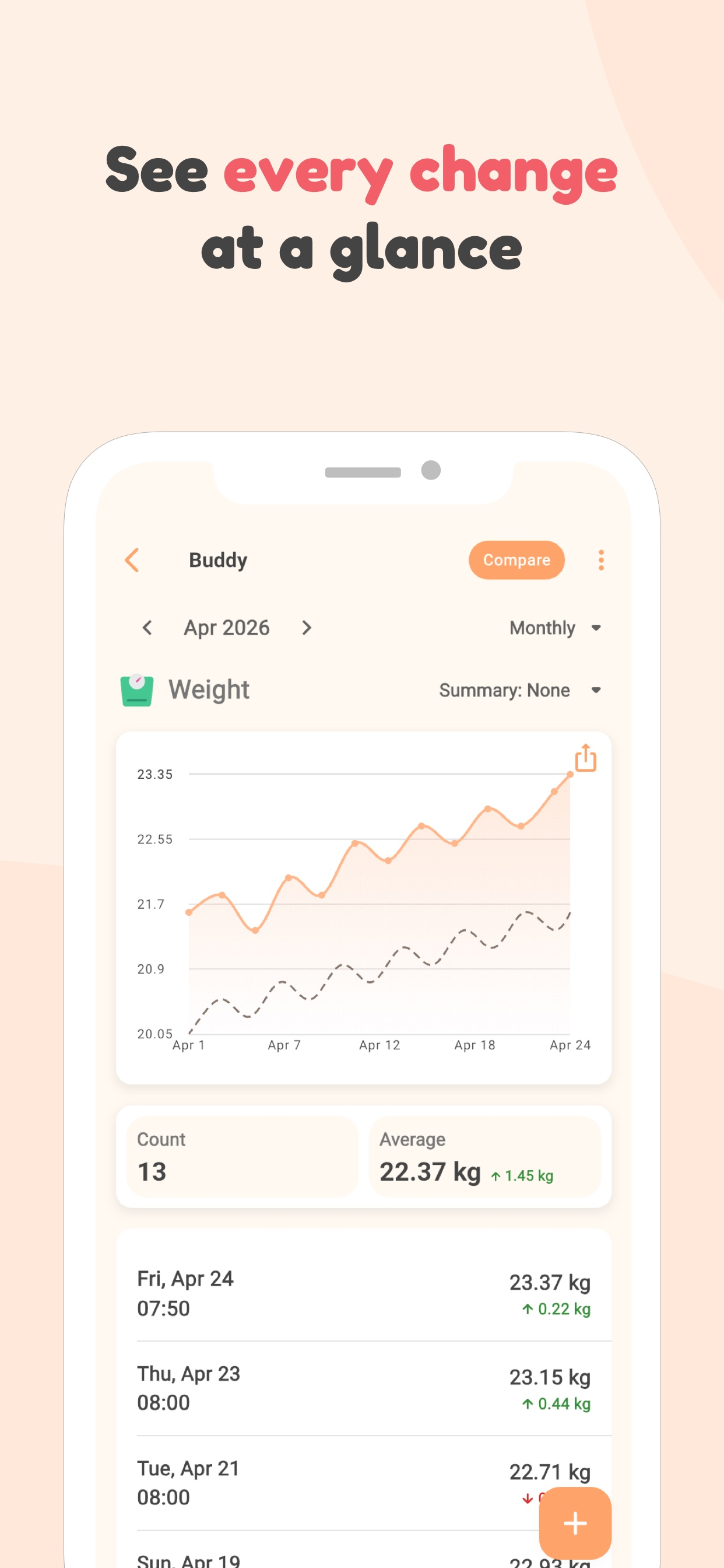
Track your dog's weight the easy way
Log weights, see the trend, and share with family — free on the App Store.


This guide is for general information only — always consult your veterinarian about your pet's health.