
Kitten Weight Chart by Age: Month-by-Month Growth
Updated July 2026
As a rough guide, a kitten weighs about 100 grams (3.5 oz) at birth and gains roughly one pound per month for the first six months — so around 1 lb at one month, 2 lb at two months, and so on up to about 5–6 lb at six months. Breed and build change these numbers, so the steady upward trend matters far more than hitting an exact figure. Weigh your kitten weekly and log each result to make sure it keeps climbing.
How much should my kitten weigh?
Newborn kittens are tiny — usually around 100 grams, about the weight of a small apple. From there they grow astonishingly fast. A healthy kitten roughly doubles its birth weight in the first week or two, then settles into a steady climb that many owners remember with the "one pound per month" rule of thumb.
That rule is a handy shortcut, not a law. It works reasonably well from about one month to six months of age, after which growth slows down as the kitten approaches its adult size. Large breeds like Maine Coons keep growing for much longer and end up far heavier, while petite breeds level off sooner. Treat any chart as a general expectation, not a target your kitten must hit exactly.
Kitten weight chart by age
Here is a simple month-by-month guide for an average domestic kitten. Use it to check that your kitten is trending upward, not to panic over a few ounces either way.
| Age | Approx. weight | What's happening |
|---|---|---|
| Newborn | ~100 g (3.5 oz) | Eyes closed, fully dependent on mom |
| 1 month | ~1 lb (450 g) | Eyes open, starting to walk and explore |
| 2 months | ~2 lb (900 g) | Weaning, ready for a new home |
| 3 months | ~3 lb (1.4 kg) | Playful, first vaccinations underway |
| 4 months | ~4 lb (1.8 kg) | Baby teeth falling out |
| 5 months | ~5 lb (2.3 kg) | Growth beginning to slow |
| 6 months | ~5–6 lb (2.3–2.7 kg) | Adolescent; often spay/neuter age |
Remember that these are averages. A dainty female may sit below every row and be perfectly healthy, while a big-boned male may run above it. The point of the chart is the shape of the line, not the individual numbers.
Tip: Small kitchen or postal scales are ideal for young kittens — they read in grams and pick up the tiny changes a bathroom scale would miss. Pop the kitten in a bowl or box on the scale, then subtract the container's weight.
The one-pound-per-month rule (and its limits)
The one-pound-per-month rule is popular because it is so easy to remember: your kitten's age in months is roughly its weight in pounds until about six months. If your two-month-old is around two pounds and your four-month-old is around four, growth is on track.
Where the rule breaks down is at both ends. Very young kittens gain in grams, not pounds, so the rule only becomes useful after weaning. And once a kitten passes six months, the curve flattens as it matures — an eight-month-old is not usually eight pounds. Use the rule as a quick sanity check, then rely on the actual trend you record over time.
When growth stalls: a vet flag
A kitten that stops gaining weight, loses weight, or falls well behind its littermates needs veterinary attention. Fast-growing bodies have almost no reserves, so a kitten that goes off its food can decline quickly. Warning signs worth a same-day call include a flat or dropping weight over several days, refusing to eat, lethargy, diarrhea or vomiting, and a swollen or painful belly.
This is exactly where a written record earns its keep. If you can tell your vet "she gained steadily until Tuesday, then lost 40 grams over three days," that timeline is far more useful than "she seems a bit off." Regular weigh-ins turn a vague worry into concrete information your vet can act on.
Transitioning to adult cat weight
Most cats reach roughly their adult size by around twelve months, though large breeds fill out over a longer period. A typical adult domestic cat settles somewhere around 8–10 pounds, but healthy adults range widely by breed and frame. As with kittens, your vet judges an adult's condition using a hands-on body condition score — feeling for the ribs and looking for a waist — rather than a single ideal number.
Once growth levels off, your job shifts from "is she gaining enough?" to "is she holding steady?" Continuing to weigh your cat every month or two helps you catch the slow creep toward overweight, or the gradual loss that can signal illness, long before it becomes obvious by eye. The habit you build during kittenhood pays off for the rest of their life.
Track your kitten's growth with PetnotePlus
Watching numbers climb is much easier when they are all in one place and plotted for you. Here is how to follow your kitten's growth in the free PetnotePlus app:
- Add a profile for your kitten. Enter their name, photo and birthday so their age is always right there next to the numbers.
- Log each weigh-in. Record the weight in Today's Entries in seconds, and attach a photo so you can watch them grow week by week.
- Set a weekly reminder routine. A weekly routine means you never forget a weigh-in during the fast-growing months.
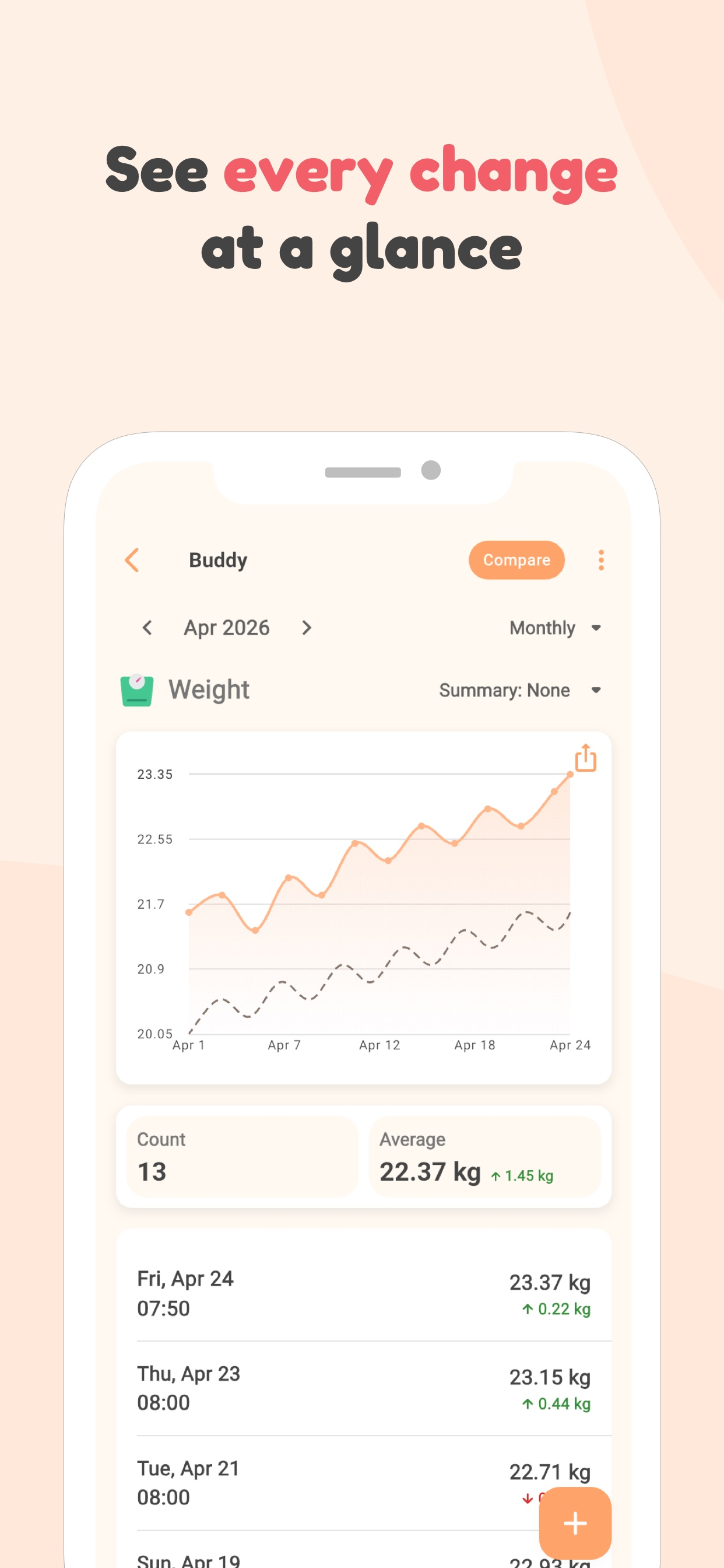
- Open the growth chart. See the trend climb over weeks and months, and spot instantly if the line ever flattens.
- Share with your family. Share your kitten with up to 15 family members so everyone can help — and everyone sees the same history.
Follow your kitten's growth the easy way
Log weigh-ins, see the growth chart, and share with family — free on the App Store.


This guide is for general information only — always consult your veterinarian about your pet's health.