
Budgie & Cockatiel Weight Chart: Healthy Ranges in Grams
Updated July 2026
Birds are masters at hiding illness — by the time a bird visibly looks unwell, the disease is often already far along. Weight is the earliest health signal an owner can catch. This guide covers healthy weight ranges for budgies, cockatiels, lovebirds and other popular pet birds, plus how to weigh your bird correctly and keep the record going.
Healthy weight ranges by species
Start with the typical range for your bird's species. Knowing the ballpark makes any change easier to judge.
| Species | Typical weight range |
|---|---|
| Budgerigar (budgie / parakeet) | 30–40 g (1.1–1.4 oz) |
| Java sparrow (Java finch) | 22–27 g (0.8–1.0 oz) |
| Cockatiel | 80–110 g (2.8–3.9 oz) |
| Peach-faced lovebird | 45–60 g (1.6–2.1 oz) |
| Fischer's & masked lovebirds | 40–55 g (1.4–1.9 oz) |
| Green-cheeked conure | 60–80 g (2.1–2.8 oz) |
These numbers are only guidelines — build and individual variation are significant. What matters more than comparing against the chart is knowing your own bird's normal weight and noticing when it moves away from it. Your bird's healthy weight is its true baseline.
How to weigh a budgie, cockatiel or finch
A kitchen scale plus a perch is all you need
With pet birds, changes of a single gram matter, so a kitchen scale that measures in 0.1 g increments is ideal. Weighing takes seconds:
- Place a perch (or a basket or cup) on the scale.
- Press the tare (zero) button so the display reads 0.
- Have your bird step onto the perch and read the number once the display settles.
If your bird is hand-tame, use a treat to teach it to step onto the scale perch — daily weigh-ins become quick and stress-free. If it won't step on, weigh it inside a carrier or a covered basket and subtract the container's weight afterwards.
The best time: every morning, before breakfast
A bird's weight swings by a few grams over the day with meals and droppings. To read the trend correctly, weigh every morning under the same conditions — before out-of-cage time or breakfast. For a small bird, a few grams is the equivalent of several kilograms for a human.
Why daily weighing is worth it
Unlike dogs and cats, birds go downhill fast. It's not unusual for a bird that "looks a bit fluffed up" to already be seriously ill. A daily weigh-in is the most reliable health check an owner can do. A bird can appear to be eating while only cracking the seed hulls and swallowing nothing — the scale will always tell you.
How to keep the record going — and read the graph
What really matters in weight tracking is not any single number but the trend. A weight that looks normal on its own can, on a graph, turn out to be part of a slow decline over several weeks — a pattern that can be an early sign of illness. Records also reveal your bird's personal rhythms: weight naturally fluctuates during molting and hormonal seasons, so with a log you learn patterns like "always a little lighter this time of year".
The easiest way to see the trend is a graph. The free pet health app PetnotePlus makes a daily weight log easy to keep up:
- Automatic weight charts. A few seconds to log, and the trend appears at a glance.
- Works for birds and every other animal. Create your own tracking items — alongside weight you can log food (seed and pellets), droppings and molting.
- Routine reminders so you never forget. Set a notification like "morning weigh-in" every day.
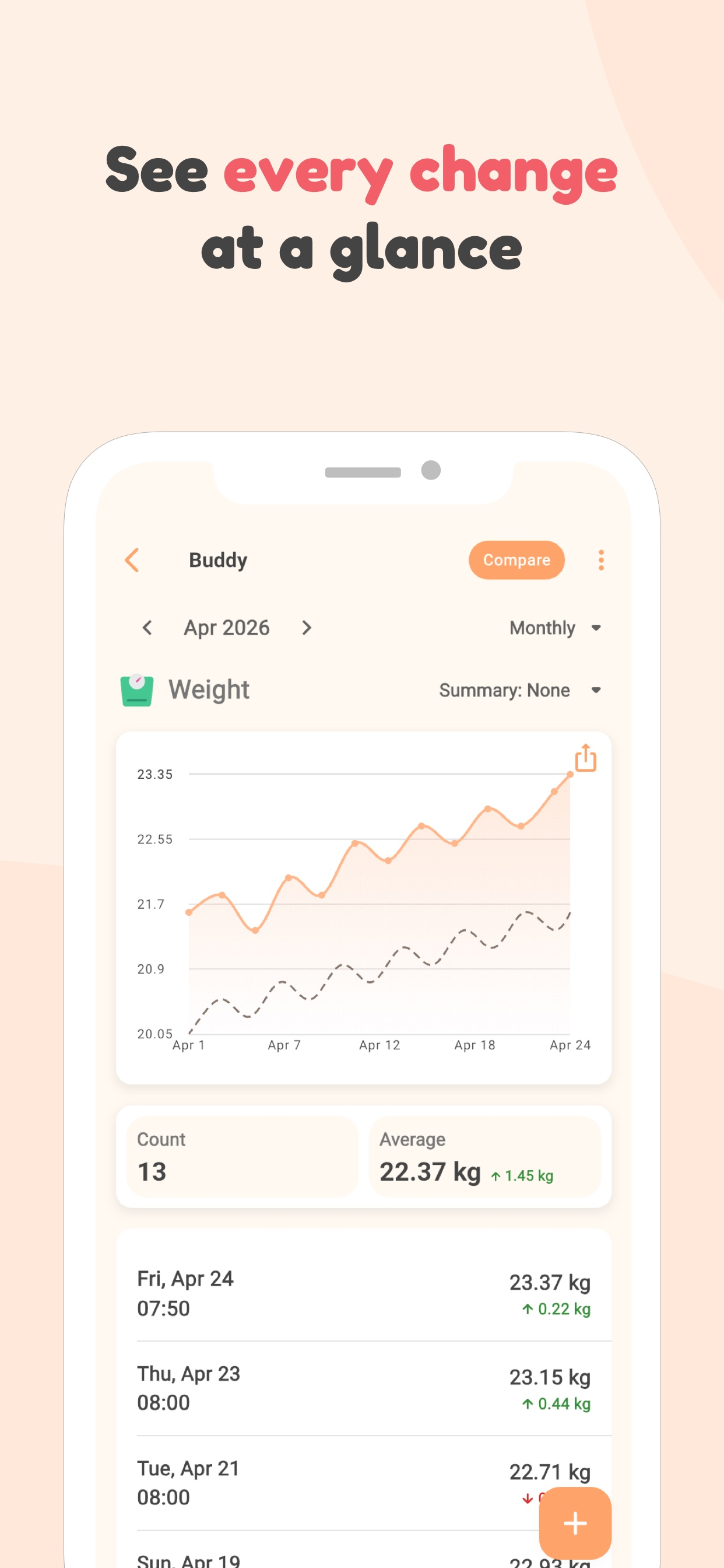
Your bird's weight log made easy
Log it and it's charted. Reminders keep weigh-ins on schedule — free to use.


Checklist when your bird is losing weight
If you notice the weight dropping, check these points as well. Being able to report them makes your vet's job much easier.
- How much it's actually eating: a bird may crack seed hulls without eating the contents — check the leftovers and the hulls
- Droppings: any change in size, color or water content? Small droppings are a sign the bird isn't eating
- Fluffed feathers: is it sitting fluffed up and still during the day?
- Activity: less singing and chatter? Dozing on the perch all day?
- Molting or hormones: could this be a temporary dip from molting or breeding season?
As a rule of thumb, a drop of 10% or more from your bird's usual weight (for example, a budgie going from 35 g to 31 g) is a reason to see an avian vet even without other symptoms. A bird's condition can crash within days, so don't let "wait and see" drag on.
Frequently asked questions
How often should I weigh my budgie or cockatiel?
Daily is ideal, under the same conditions each time — first thing in the morning before breakfast works well. Birds are small and decline fast, so a weekly weigh-in can miss the early signs of illness. If daily isn't realistic, keep it up at least two to three times a week.
What kind of scale should I use to weigh a bird?
A kitchen scale that measures in 0.1 g increments is ideal. Place a perch or basket on the scale, press the tare (zero) button, then have your bird step on. Training your bird to step onto the scale perch makes daily weigh-ins quick and easy.
How much weight loss means my bird should see a vet?
As a rule of thumb, a drop of 10% or more from your bird's usual weight (for example, a budgie going from 35 g to 31 g) warrants a vet visit even without other symptoms. If it comes with fluffed-up feathers, reduced appetite or changes in droppings, go sooner.
This guide is for general information only — always consult your veterinarian about your pet's health.